Skip to content
Product category

Gate Valves

Isolation valves with a wedge that moves across the flow path, for fully open or fully closed service.

14 products

About gate valves

A gate valve opens and closes by raising or lowering a wedge across the bore. When fully open the wedge sits clear of the flow, so the valve adds very little resistance to the line. That makes gate valves a common choice for isolating pumps, mains and branch lines in water, wastewater, oil, gas and steam systems.

Gate valves are designed to be either fully open or fully closed. Using a gate valve partly open to regulate flow causes vibration and wears the wedge and seats, so a globe valve or butterfly valve is the usual choice for throttling.

Rising spindle or non-rising stem?

On a rising spindle gate valve the stem travels up through the handwheel as the valve opens, so the open or closed position can be seen at a glance. A non-rising stem valve keeps the stem inside the bonnet, which needs less headroom and suits buried service or valve chambers. GMC datasheets list both versions for several materials and ratings; compare them below.

Gate valve types

  • By stem: rising spindle (rising stem) and non-rising stem (NRS).
  • By body material: cast iron, ductile iron and carbon steel in GMC's range. Ductile iron is tougher than grey cast iron; steel suits higher temperatures and pressure classes.
  • By pressure rating: PN-16 and PN-25 (EN flanges) or ASME Class 125, 150 and 300, depending on the model.
  • By size: GMC's gate valve datasheets cover DN50 (2″) up to DN800 (32″), depending on the model.

Gate valve parts

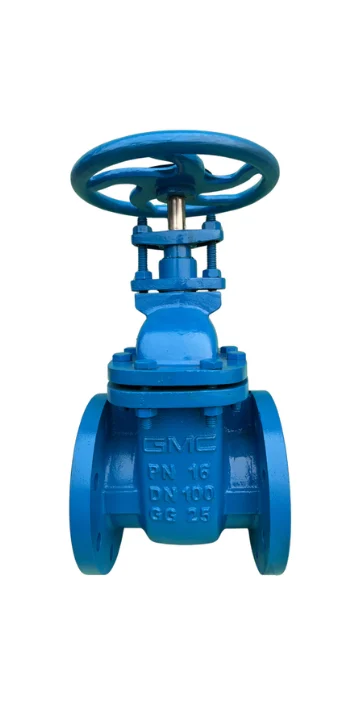
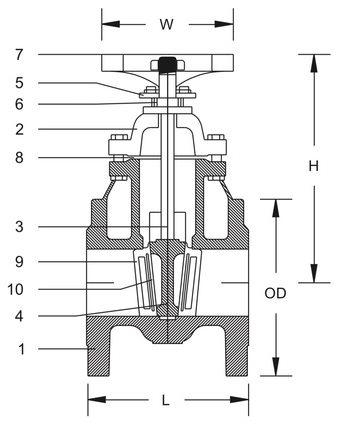
The main components of a gate valve are the body (holds the pressure and connects to the pipe flanges), the bonnet (bolted to the body to enclose the moving parts), the wedge or gate (closes the bore), the seat rings (the sealing faces), the stem or spindle (moves the wedge), the gland packing (seals around the stem) and the handwheel. Each GMC product page lists every part and its material from the datasheet.

Gate Valves: FAQs

Can a gate valve be used to control flow?
Gate valves are intended for fully open or fully closed isolation. Throttling with a partly open gate causes vibration, noise and seat wear. For flow regulation, consider a globe valve or a butterfly valve.
What are the types of gate valves?
Gate valves are usually grouped by stem design (rising spindle or non-rising stem), body material (for GMC: cast iron, ductile iron or carbon steel), pressure rating (PN-16, PN-25, Class 125, 150 or 300) and size. Each GMC product page shows one combination with its full dimensions.
What are the parts of a gate valve?
Body, bonnet, wedge (gate), seat rings, stem (spindle), gland packing and handwheel, plus the bolting and gaskets that join them. The materials of each part are listed on every GMC product page.
What is the difference between a rising spindle and a non-rising stem gate valve?
On a rising spindle valve the stem moves up as the valve opens, so the position is visible. On a non-rising stem valve the stem only turns, which saves headroom and suits underground or confined installations.
What is the price of a gate valve in Pakistan?
The price depends on the size, pressure rating, body material, end connection, quantity and any testing or documents required, so GMC quotes each enquiry individually. Send the sizes, ratings and quantities through the quote form and GMC will reply with a written quotation.

Need help choosing?

Send your line conditions (medium, pressure, temperature, size) and GMC will recommend from the gate valves range.

Get a Quote